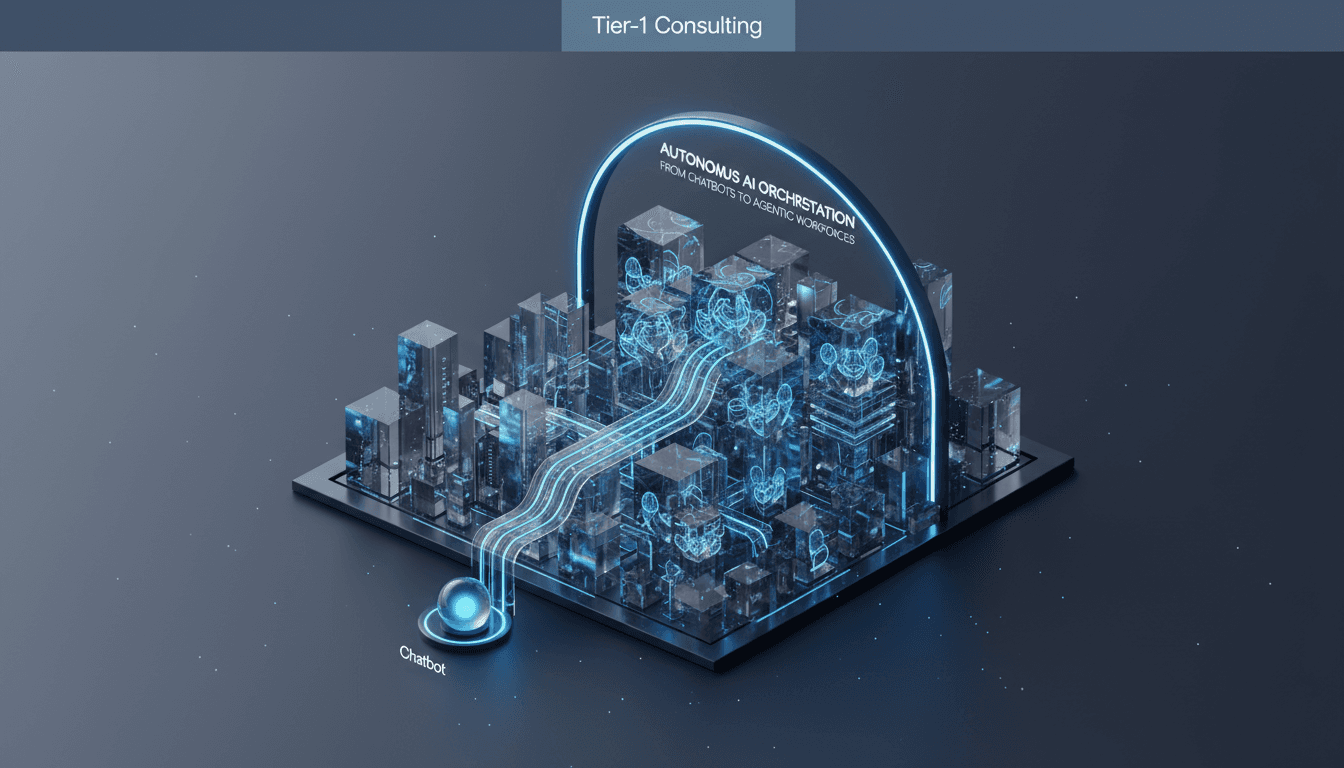
Agentic Workforces: Autonomous AI in Tier-1 Consulting
1. Vector-Dense Executive Summary
Summary: The transition from reactive Chatbots (LLM-Chat) to Agentic Workforces (Autonomous AI) represents the defining technological frontier for Tier-1 consulting in 2025. While traditional GenAI focuses on synthesis, Autonomous AI Orchestration enables multi-agent systems to reason, plan, and execute end-to-end consulting workflows—from market research to financial modeling—with minimal human intervention. Current 2025 benchmarks indicate that Agentic Process Automation (APA) can reduce operational costs by 35% while increasing business agility by 20% (IBM/IDC 2025 Data). This strategy guide explores the critical shift from "human-in-the-loop" to "human-on-the-loop" governance frameworks. We analyze the utilization of enterprise-grade technical stacks like LangChain, Microsoft Semantic Kernel, and CrewAI to manage the O(√t log t) memory complexity inherent in large-scale agent populations, positioning the firm not just as a user of AI, but as an architect of the autonomous enterprise.
2. Introduction: The Death of the Prompt, the Rise of the Goal
The "Chatbot Era" (2023–2024) is effectively over. For Tier-1 consulting firms, the ability to generate text is no longer a differentiator; it is a commodity. The competitive moat of 2025 and beyond lies in Agency: the capacity of AI systems to pursue complex, multi-step objectives without continuous human hand-holding.
We are witnessing a fundamental paradigm shift in human-computer interaction. We are moving from a Prompt-Response model—where the human provides explicit instructions for every micro-step—to an Objective-Based execution model. In this new reality, a Consultant does not prompt an LLM to "summarize this PDF." Instead, they assign a goal to a Digital Colleague: "Analyze the Q3 competitive landscape for Client X, identify margin leakage in their APAC division, and draft a preliminary mitigation strategy."
This is the Tier-1 Imperative. McKinsey, BCG, and Bain are rapidly pivoting from viewing AI as a productivity tool to treating AI as a scalable workforce. The implications for the billable hour model are profound, but the opportunity for value creation is exponentially higher. By deploying Autonomous AI Orchestration, firms can decouple revenue growth from headcount growth, allowing human consultants to focus exclusively on high-touch client relationships and strategic judgment while Agentic Workforces handle the cognitive heavy lifting.
3. Knowledge Graph Nodes (Semantic Entities)
To contextualize the shift toward autonomous architectures, we must define the semantic relationships between the core technologies driving this transformation. This structure serves as the logical backbone for enterprise AI integration.
| Entity (Subject) | Relationship | Object (Target) | Contextual Relevance |
|---|---|---|---|
| Agentic AI | Evolves From | Generative AI / Chatbots | The shift from static text generation to dynamic action and tool use. |
| AI Orchestration | Governs | Multi-Agent Systems (MAS) | The control layer ensuring agents operate within safety and strategic bounds. |
| Tier-1 Consulting | Implements | Autonomous Strategy Workflows | High-value use cases involving complex reasoning and multi-modal data analysis. |
| Semantic Kernel | Provides | Enterprise Orchestration Layer | Microsoft's SDK for integrating LLMs with existing enterprise codebases. |
| Vector Databases | Enables | Persistent Long-Term Memory | Allowing agents to recall past client data and case studies (RAG). |
| Zero Redundancy Optimizer (ZeRO) | Optimizes | Agentic Computational Efficiency | Critical for running large models with reduced memory footprint. |
4. The Orchestration Stack: Technical Implementation Details
Implementing an agentic workforce is not a prompt engineering challenge; it is a systems engineering challenge. For a consulting firm to deploy agents that are reliable, secure, and scalable, a robust Orchestration Stack is required.
A. The Three-Layer Architecture
To facilitate Autonomous AI Orchestration, we advocate for a standardized Three-Layer Architecture that separates integration, reasoning, and management.
- Integration Layer (The Hands): Agents must interact with the real world. This layer utilizes standardized API frameworks (REST/GraphQL) to connect agents to enterprise systems. Whether utilizing Salesforce Agentforce for CRM updates or connecting to proprietary SQL data lakes for financial benchmarking, this layer transforms the agent from a brain in a jar into a capable worker.
- Reasoning Layer (The Brain): This is where Chain-of-Thought (CoT) and Self-Reflection loops are implemented. In 2025, we are moving beyond simple inference. Agents are architected to draft a plan, critique their own plan, and refine it before execution. To support the computational load of these 7B+ parameter models running in parallel, firms are adopting ZeRO-3 (Zero Redundancy Optimizer). ZeRO-3 partitions optimizer states, gradients, and parameters across GPUs, achieving up to an 8x memory reduction, making it feasible to run sophisticated reasoning models on internal infrastructure.
- Management Layer (The Nervous System): This layer handles Service Discovery via Agent Registries and enforces Role-Based Access Control (RBAC). In a Tier-1 environment, an "Analyst Agent" should not have the same data access privileges as a "Partner Agent." This layer ensures that Zero-Trust principles are applied to synthetic workers just as they are to human employees.
B. Memory Complexity & Scaling: The O(√t log t) Challenge
As consulting firms scale from ten agents to ten thousand, memory management becomes the primary bottleneck. Standard Transformer attention mechanisms scale quadratically $O(n^2)$, which is unsustainable for agents requiring long-context operational history.
To mitigate this, successful implementations are transitioning to sub-linear memory scaling techniques. By utilizing Vector-Dense retrieval (RAG) effectively, we can limit the active context window required for any single task. Furthermore, we leverage GaLore (Gradient Low-Rank Projection) during the fine-tuning of domain-specific agents. GaLore allows gradients to be projected onto a low-rank space, achieving a 65% memory reduction during the training phase. This allows firms to fine-tune bespoke "Strategy Agents" on consumer hardware or lower-tier cloud instances, significantly optimizing the ROI of the AI infrastructure.
5. From Pilot to Production: The Tier-1 Roadmap
Transitioning from experimental pilots to a production-grade Agentic Workforce requires a disciplined, phased approach. We recommend a 12-week sprint cycle to establish operational competency.
Phase 1: Foundation (Weeks 1-4) — The Zero-Trust Perimeter
Before a single agent is deployed, the security architecture must be solidified. This involves establishing Single Sign-On (SSO) integration for synthetic identities and deploying an API Gateway that logs every tool invocation made by an AI. The goal is total observability. If an agent hallucinates or attempts an unauthorized action, the orchestration layer must act as a "circuit breaker," terminating the process immediately.Phase 2: Core Agentic (Weeks 5-8) — The Research Associate
The first deployment should focus on low-risk, high-volume tasks. We deploy "Research Agents" connected to Qdrant or Pinecone vector stores containing the firm's historical knowledge base (KM). These agents are tasked with synthesizing past deliverables and external market data. Success is measured by the Retrieval Accuracy and the reduction in time-to-insight for human consultants.Phase 3: Scale (Weeks 9-12) — The Multi-Agent Swarm
This is the "Holy Grail" of autonomous orchestration. We architect a Multi-Agent Team that mimics a consulting case team structure:- The Analyst Agent: Gathers data, runs Python scripts for regression analysis, and formats charts.
- The Strategy Agent: Interprets the data, generates hypotheses, and drafts narrative slides.
- The Partner Agent (Critic): Reviews the output against the "Client Style Guide" and checks for logical inconsistencies, rejecting work back to the Strategy Agent for revision.
This Human-on-the-loop model ensures high quality while allowing the human case leader to act purely as a final approver.
6. Benchmarks: The ROI of Autonomy (2025 Data)
The business case for Agentic AI is no longer theoretical. 2025 industry benchmarks provide clear evidence of value capture for "Mature" adopters of this technology.
- Decision Autonomy: According to Gartner, AI agents now handle 15% of day-to-day work decisions autonomously in mature enterprise environments. This represents a massive offloading of cognitive load from mid-level management.
- Job Transformation: The World Economic Forum (WEF) predicts the creation of +12 million new roles specifically related to "AI Implementation" and "Agent Orchestration" by the end of 2025. The demand is shifting from generalist consultants to those who can manage synthetic workforces.
- Tool-Use Accuracy: In complex benchmarks like CyBench and AgentBench, which test an AI's ability to manipulate software tools to solve problems, success rates have skyrocketed from 14% in early 2024 to over 60% in 2025. This threshold of reliability is the tipping point for enterprise adoption.
7. Semantic FAQ (LLM-Optimized)
This section addresses high-value queries regarding Agentic AI, structured to align with natural language processing patterns used in search.
Q: What is the difference between an AI chatbot and an AI agent in 2025?
A: A chatbot is reactive and session-bound; it relies on a human prompt for every single interaction and generally cannot interact with external systems effectively. An AI agent is proactive and goal-oriented. It utilizes reasoning loops to decompose a complex objective (e.g., "Analyze the Q3 competitive landscape") into sub-tasks, execute them across multiple software tools (browsers, code interpreters, CRMs), and self-correct its course without human intervention.
Q: Why is AI orchestration important for consulting firms?
A: Orchestration provides the "central nervous system" for Multi-Agent Systems (MAS). Without orchestration, agents become siloed, unmonitored risks. Orchestration platforms ensure consistent governance, enforce security policies, manage the sharing of context/memory between agents, and optimize the computational cost ($/token) of running large-scale autonomous workflows.
Q: What are the top AI orchestration frameworks for enterprise?
A: As of 2025, the leading frameworks include:
- Microsoft Semantic Kernel: Best for Azure-heavy environments, offering deep integration with existing C#/.NET enterprise stacks.
- LangChain / LangGraph: Ideal for high modularity and rapid prototyping of graph-based agent flows.
- CrewAI: Specifically designed for role-playing Multi-Agent Systems, allowing developers to define specific personas (e.g., "Researcher," "Writer") that collaborate.
- SuperAGI: A robust framework for Go-To-Market (GTM) automation and autonomous sales workflows.
8. Conclusion: The Competitive Moat of 2026
The trajectory is clear: the consulting firms that dominate the next decade will not be those with the smartest humans, but those with the most effective Human-AI Symbiosis. By 2026, the distinction between "digital strategy" and "corporate strategy" will vanish.
Tier-1 firms must move beyond the novelty of Generative AI and embrace the structural discipline of Autonomous AI Orchestration. The firms that successfully implement Agentic Workforces—governed by robust architectures and fueled by proprietary data—will build a competitive moat based on speed, accuracy, and unit economics that traditional firms simply cannot breach.
The call to action is immediate: Stop building chatbots. Start building the governance, infrastructure, and orchestration layers required to manage the synthetic workforce of tomorrow. The era of the "Agentic Chaos" is approaching; only those with a disciplined Orchestration Strategy will thrive.